What is the basis for neural plasticity?

The current view of LTP/LTD and specifically AMPA-dependent plasticity, which underlies all theoretical work on neural networks, seems exceedingly narrow. It leaves out levels of plasticity that are well known, like epigenetic modifications, or internal protein signaling, in order to come up with a simple model of use-dependent plasticity, the Hebbian principle, or ‘neurons that fire together, wire together’.

It is interesting and important to tackle the complex task of reducing the large number of individual findings on behavioral memory and neural plasticity into a small set of principles that can be used for models of biologically realistic memorization. Such models should offer capabilities beyond machine learning, namely conceptual abstraction, information filtering, building knowledge.

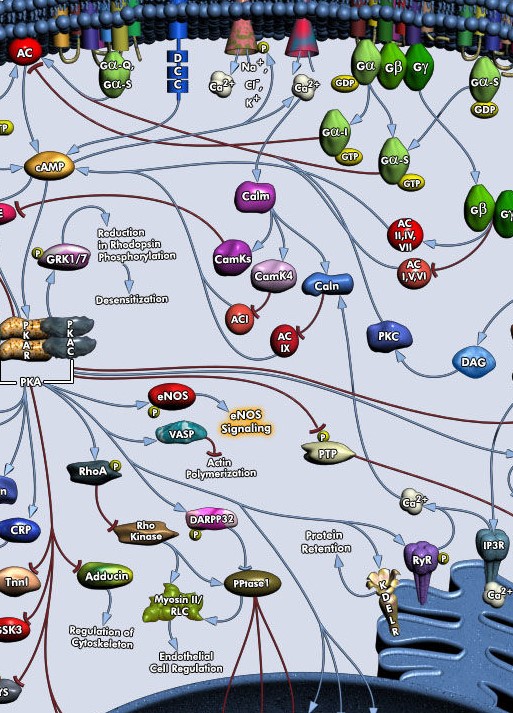
Here is one such observation: Both AMPA receptor placement and dendritic ion channel expression are regulated by similar, overlapping internal protein pathways. These protein pathways are activated by NM receptors and by NMDA and L-type-calcium channel-based calcium influx. We may conjecture that NM receptors and NMDA-based calcium activation together orchestrate neural plasticity via e.g. the calcium/CaMKII route, and the cAMP/PKA/ERK route, and that these pathways are acting in synergy at the synaptic AMPA sites as well as on the dendritic/synaptic ion channel expression sites.

So what this means is that various forms of intrinsic and synaptic plasticity are guided by the same protein pathways and therefore can be expected to be activated together. Here are specific instances of this synergy:

For instance, strengthening of AMPA could be accompanied by insertion of Sk-channels and reduction of L-type calcium channels, which blocks the synapse from further strengthening (‚overwrite protection‘). Such a mechanism has recently been identified as necessary for the stability and the lasting memorization capabilities of a network. Activation of the cAMP pathway activates Ih (HCN channels) which decreases the intrinsic excitability of the neuron, and allows less synaptic input to be processed. In a way, this kind of activation could be used as a temporal lock to prevent high dendritic excitability after the NM system has become engaged and plasticity in the neuron has started. Vice versa, in the absence of cAMP, dendritic excitability is high and many synaptic inputs are processed by an increase of membrane resistance through a reduction of HCN. Reduction of synaptic activity also reduces dendritic HCN channels. HCN channels may therefore indicate the level of synaptic activation, where more channels limit the parallel processing of synaptic input.

Internal Memory: An Example

A protein Er81 which is present in about 60% of parvalbumin interneurons (parvalbumin is a calcium buffer which is fast, in contrast to calbindin) in layer II/III in the cortex of mice has been found to have an effect on the latency of spiking in these interneurons. (Er81 is also found in layer V pyramidal cells, there are also publications about that). This is mediated by the expression of the Kv1.1 potassium channel. Neurons with low Er81 expression have less Kv1.1, and these neurons, fast spiking basket cells, respond without latency. These neurons receive both E and I input. Neurons with high Er81 expression have more Kv1.1 channels, and these neurons (primarily basket cells again) have noticeable latencies. In slices it was found that cells of this kind have mostly E input and much less I input.
It then was shown that these ‘types’ of neurons actually undergo adult plasticity. A simple experiment – stimulation with kainate, and inhibition with nifedipine, a L-type calcium blocker – showed that Er81 expression was regulated inversely proportional to total network activity, and that this was observable after approximately two hours. So this is a kind of internal plasticity on the same time scale as LTP/LTD.
Additional experiments showed that Er81 plasticity was mediated by calcium entry into the cell (as so many other forms of plasticity), so we have evidence for a cell-specific regulation of Er81.
More precisely, the internal memory is the level of Er81. This can be a long-term storage element and remain constant over long time periods. The plasticity is intrinsic, i.e. in the expression of ion channels. The internal memory sets a parameter on the membrane (µKAs cf. Scheler 2013). When the internal memory changes – a new value emerges, the old value is overwritten – then there is a read-out at the membrane in terms of the µKAs parameter. So in this particular case, it seems as if the internal value is superfluous, and the µKAs is identical to epsilon Er81. But this is a mistake, in reality, µKAs is set by a number of factors, and epsilon ER81 very probably has other effects in the system as well.
It is not clear from this work, why the innervation by E and I neurons is different,  and also how and whether this changes, on the same time scale, or at all.
A surprising observation from this paper is also that high activity causes latencies of interneurons to appear, but low activity abolishes them. One might think that with less latency, there is more inhibition in the network, and high activity abolishes latencies to upregulate inhibition. That is not the case.
Without a simulation, I’d guess that inhibitory latencies reduce excitatory pressure; where activation is stored in the membrane potential of I neurons without letting them spike. There is then reduced spiking of I neurons, but still a reduction of overall excitation in the network, since the capacity of the I neuron to buffer synaptic input is enhanced. These neurons receive mostly E input, because they have this buffer capacity, no-latency neurons in contrast participate in disinhibition – they respond to the level of inhibition as well and adjust their activity. There is more activity stored in the network with longer latencies but less spiking. This is just a guess concerning the behavior of a real network.
Summarizing: A cytoplasmic protein Er81 regulates the density of Kv1.1 channels, which is a form of intrinsic plasticity that is set by a cell-internal calcium-related parameter. Neuronal activation of course increases calcium entry, so the internal parameter is influenced by external signals. The density of Kv1.1 channels influences spike latency and overall spike frequency. There is no synaptic plasticity in this scenario.
 Tuning of fast-spiking interneuron properties by an activity-dependent transcriptional switch
Nathalie Dehorter etal.
Science  11 Sep 2015: Vol. 349, Issue 6253, pp. 1216-1220
DOI: 10.1126/science.aab3415